
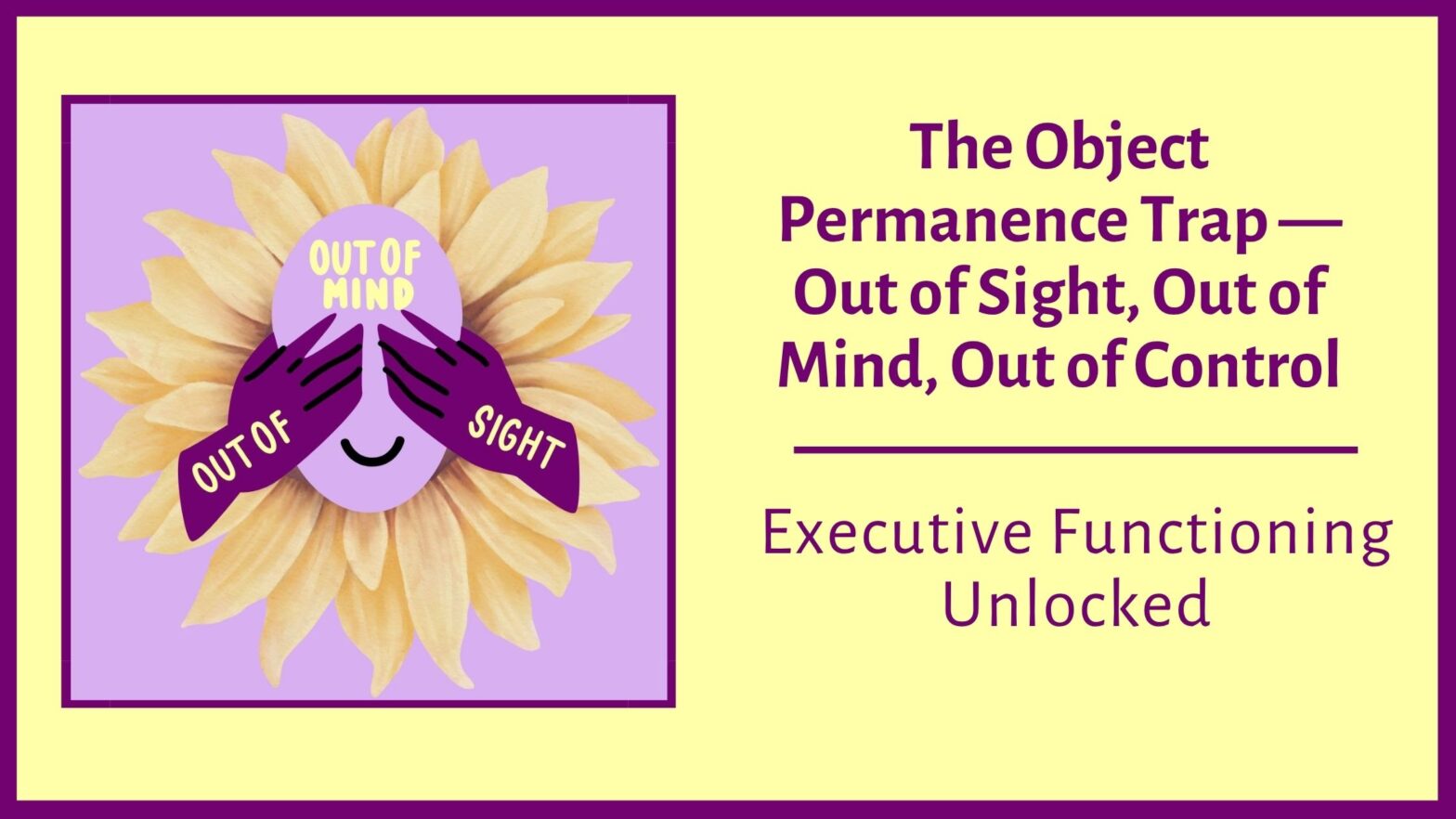
The Object Permanence Trap – Out of Sight, Out of Mind, Out of Control
Executive Functioning Unlocked
“If I Don’t See It… Does It Still Exist?”
You put something “somewhere safe,” and suddenly it’s gone from the timeline of your life. You successfully put away leftovers instead of throwing them out…..only to forget they existed in the fridge of mystery containers?
You got snagged by the Object Permanence Trap – a very normal, sometimes super annoying, ADHD experience. The one where things don’t slip your mind, they literally cease to exist in the chaos of your brain.
This is not just being “scatter-brained.” ADHD brains are just wired that way – if a thing isn’t visible, loud, or actively flashing lights to get your attention….it pretty much doesn’t exist. Then when the chaos of life starts chaosing – even the super important things can vanish from your mind.
The great news is that while annoying, it’s absolutely something you can accommodate.

Your Brain Isn’t Broken — It’s Overloaded
First and foremost – let’s clear something up: forgetting something the minute it’s left your line of sight isn’t a sign that you don’t care about it, that you don’t try hard enough, or are “never going to get your life together.” It’s a sign that your brain has 57 tabs open, half of them are frozen, and you have no idea which one is playing music.
Try thinking about your ADHD brain’s working memory is less of a filing cabinet and more like a white board. Or maybe an etch-a-sketch. There’s only so much room on the white board and every time something is added, something else is quietly erased. That’s not because you are “bad at adulting” – it’s because your brain is wired for novelty, urgency, and current interest.
When all that leads to things like lost items, rotten food, missed deadlines or important dates – that’s when the Shame and Guilt Monsters sneak in. We carry years of messages about why didn’t we remember, why can’t we get it together, and have we tried using a d&%n planner? But those expectations were built for neurotypical brains that are built for storing information differently. You deserve some grace. And a reframe.
Here it is – your brain isn’t failing, it’s overloaded. Now you can start to build systems that lighten the load and accommodate your brain instead of blaming yourself for being who you are.
The Brain Science Behind “Poof – It’s Gone!”
Now that we agree that this isn’t a character flaw, we can look at why our brains do this disappearing act. Let’s chat about what’s really going on behind the scenes.
- Executive Function Challenge – Working Memory Limitations.
- Have you ever seen a cartoon where a person is in a boat that has holes in it and they are frantically trying to plug the holes and scoop water? That’s kind of what ADHD working memory is. We can hold so much in the working memory parts of our brains. (Which are different than our short and long term memory parts of our brains.)
- Transitions – Attention Shifting
- Every time we switch tasks, or are interrupted when we are focused, our brain swaps out one mental tab for the other. We love opening the new brain tabs. The problem is once our attention moves on, so does “the thing you were supposed to be doing.”
- Out Of Sight Out Of Mind
- Drawers, cabinets, boxes without labels, tupperware dishes – these are traps for our ADHD brains. It’s not just out of sight, out of mind – it’s out of sight and every thought that’s associated with it is also gone. Bills, school forms, to-do lists, half finished projects, leftovers – it all goes away the second that it’s tucked away.
- Overwhelm and Dread
- Just like your computer, too many tabs runs the risk of the blue screen of death. Or in your brain’s case, it simply shuts down and refuses to make decisions or do anything. Your brain is acting like a surge protecter – shutting it all down at once. And then when we reboot? It may have saved some of the tabs, but others are gone forever.

Now How Do We Work WITH Our Brains Instead of Against Them?
You know by now that the answer isn’t just to “try harder” or “write it down” or “pay attention.” We’ve tried all those, right? The magic happens when you design your routines and your environments that match how your brain works naturally.
We aren’t aiming for perfection, we are aiming for creating a path of least resistance to make it easier for your brain. Let’s chat about a few ADHD friendly tools and tips that support struggles with object permanence without relying on brute forcing our memory.
- Keep It Visible – Within Boundaries
- Our brains pay attention to what they see. So visibility is key to these challenges.
- Caveat – Too much busy will turn our brain to “sleep” mode and we won’t even notice. A few sticky notes we may pay attention to, 25 we will simply not notice.
- Keep what you need most where you can see it.
- Give Important Things A Designated Home
- Have a launch pad – A designated place for the important things that you need to get out the door. You want to make it easier to get out of the door. Keys, wallets, backpacks, etc.
- Create a “safety or wellness corner” – for vitamins, bandaids and other similar items.
- Specific places that you put your jewelry items in.
- A “hot spot” – where things that need to be done soon live – bills to be paid, permission slips to sign, etc.
- All this is designed to give your brain less to think about.
- Organize For Your Brain
- Use clear bins instead of opaque or colored boxes or baskets
- Label with large easy to read labels anything you can’t see through – bins and boxes, drawers, etc.
- Try an open-shelf kitchen
- Use clear containers with labels for leftovers (and add the date)
- Bonus Tip – leave a whiteboard on your fridge and write on it when you add leftovers – it might help you remember they are in there next time you want a snack.
- External Tools To Hold Information For You
- Use whiteboard, visual dash boards, sticky notes (don’t overdo it)
- Digital Reminders or Alarms – again – don’t set so many you don’t pay attention to them.
- Shared calendars for family members
- Flexible Routines
- ADHD brains thrive on routine, but are terrible at keeping them. So keep things somewhat flexible for most chances of success.
- Do a 10 minute reset before bed – making sure your items to get the next day started are ready to go.
- Create short checklists for housework that feels overwhelming. Experiment!

Design for The Brain that You DO Have, Not The One That You Think You SHOULD Have
Remember that struggles with object permanence aren’t evidence that you are scattered, lazy, or failing – it’s just a part of how ADHD manages information. And if we stop trying to “fix” that, and start designing our space with the tools to support your brain, things get a little bit easier.
And – you don’t have to figure it all out alone.
If you want support building ADHD friendly systems, understanding your brain and how ADHD impacts it, and creating a manageable and authentic life, I’d love to help. My coaching is designed for real humans – beautifully wired and wonderfully imperfect.
If you are curious about what working together might look like, please book a free discovery call any time. Let’s chat about making daily life feel a little bit lighter and more doable, one small shift at a time.
Questions? Feel free to send me an email at Kat@AllBelong.com and let’s chat!

 Don’t Delay Joy
Kat Sweeney, MCLC