Book A Call With ADHD Coach Kat Today
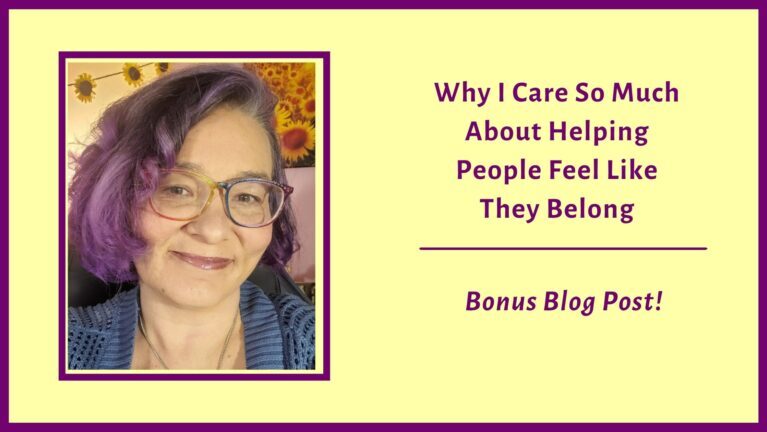
Why I Care So Much About Helping People Feel Like They Belong
Bonus Blog Post!
Belonging has been the focus of my attention over the recent years. Probably because I’ve spent a lot of time wondering where I could find it.
By second grade, it was painfully obvious that I was different. I was often the teacher’s pet. I was emotional. I talked too much and struggled to sit still. My hair wasn’t always brushed, or was greasy. I was in an unusual home situation. I was the kid that other kids picked on and teacher’s said “wasn’t living up to her potential.”
Looking back, there were many reasons for that. But at the time, I just knew that I was different than my peers. And I couldn’t seem to make myself be more like them no matter how I tried.
I think that when you’ve spent years feeling like you don’t belong, you become pretty good and looking for places where you might.
For a long time, I thought belonging meant simply being accepted. Then I thought it meant finding my people. Then I thought it meant fitting in well enough that people would hopefully decide to keep me around.
I’ve learned that those aren’t necessarily the same thing at all.
One of the hardest lessons I’ve learned over the last decade or so is that fitting in and belonging are not interchangeable.
I used to think that if I spent time with people, shared values with them, laughed with them, went through something with them, or even just worked alongside them that we belonged to one another in some meaningful way. I believed we’d be very good, lifelong friends. Sometimes that was true. Most of the time it was not.
Sometimes we belong together for a season, or a project, or a moment in time. And sometimes I wasn’t finding belonging at all. I was finding acceptance. Or usefulness. Or proximity. Those things aren’t at all bad, they just aren’t the same thing. I’ve realized that belonging feels much more nuanced than I used to think it did.
Belonging isn’t everyone liking you. (That sounds exhausting and as a 51-year old ADHD chaos human I’m far to tired to handle all that.)
It’s lowering your shoulders when you walk into the room. Because you can. It’s saying the thing you almost didn’t say and realizing that no one is keeping score. It’s not apologizing before you ask a question. It’s knowing that if you’ve disappeared for a week or forgot to text back because your brain or nervous system needed something diffferent, someone simply tells you they are glad you are back.
It’s feeling understood instead of merely tolerated. It’s being embraced for who you are, not despite it. And perhaps most importantly, it’s knowing that your presence matters and that your absense would too.
Belonging is being valued for what you bring to a relationship, a community, or a space. It’s knowing that people want you there. Not because of what you can produce or contrubite or accomplish, but because you are you.
I don’t think I’ve spent my life only looking for belonging. I’ve spent a lot of it trying to create belonging also.
I’ve volunteered in communities for decades. I’ve built community groups. I’ve facilitated conversations. I’ve mediated disagreements. I’ve welcomed people into spaces – SO may people. I’ve sat beside people while they figured out who they are.
Looking back, I don’t think that’s accidental.
I’ve always been trying to build the thing I wish existed more often. A place where people can exhale a little. A place where people don’t have to perform humanity correctly. A place where people don’t have to earn their place before they arrive.
I think that’s probably why I care so much about the work I do.
People often assume I became an ADHD coach because I have ADHD. Or because my kids did. Or because I like helping people get organized. All of those things are true, and are definitely parts of the reason. But they’ve never really been the heart of it for me.
The heart of it has always been people.
I’m angry every single time I see someone excluded, overlooked, or made to feel like they are too much, not enough, or somehow not worthy.
What makes me saddest is that these experiences happen so often that they become part of the stories that people tell themselves.
“I’m too much.”
“I’m difficult.”
“I’m lazy.”
“I’m broken.”
“I’m bad at relationships.”
I hear versions of these stories every single week. I myself believed I was too lazy or dumb to do anything important in life. It makes me hurt knowing how many people have adopted these stories.
When people leave a coaching session with me, it’s not as important to me if they remember my brilliant suggestions.
I hope that they remember that they felt seen.
Heard.
Understood.
I hope that they leave with something practical to take with them, of course, but I also hope they leave with a little more compassion for themselves than they walked in with. I hope they feel a little less alone. And maybe just a little less like they are doing the whole “adulting thing” wrong.
If you’ve spent any amount of time in my corner of the interent, you’ve probably noticed that I talk about belonging a lot. Joy too. Authenticity. Permission. Community. Rest. They are all connected for me.
Because underneath all of them is one thing I believe very deeply:
No one should have to earn the right to be fully human.
Not neurodivergent people.
Not disabled people.
Not queer people.
Not struggling people.
Not overwhelmed people.
Not messy people.
Not people who are still figuring themselves out at 51 (ask me how I know.)
None of us.
I’m still learning what belonging means for myself. I don’t have that part all figured out. I suspect I never will completely, and I’m okay with that, too.
What I do know is this.
I want the people who spend time in my little corner of the world to know they never have to apologize to me for their ADHD symptoms, big feelings, questions, messy brains, chaos, or humanity.
I don’t need them to become someone else before they arrive. I don’t need them to mask harder, try harder, or be less themselves. I don’t need perfection from them because I don’t believe that’s what makes us worthy of belonging in the first place.
I just want them to feel welcome enough to begin lowering their guard.
Maybe that’s what belonging has always meant to me.
Not fitting in, being tolerated, or earning your place at the table.
Just knowing there’s already a chair with your name on it.
You don’t have to earn your place here.
You already have one.

 Don’t Delay Joy
Kat Sweeney, MCLC, ACC