Dopamine Friendly Workday
Structuring Your Day To Balance Interest….and Obligation
ADHD At Work
Willpower does not make an ADHD brain work. No matter how hard you try. Our brains work on novelty, urgency, interest, and things of that nature. That’s why when you have a long list of “should do’s,” and suddenly find yourself reorganizing your shoes instead. It’s not laziness – it’s our brain chemistry.
typical productuctivity advice says things like, “do the hardest thing first” (or eat the frog first) – and that CAN work – sometimes. More often than not, that is the moment our brain shuts down and starts scrolling memes. If you have a workday that is designed in a dopamine friendly way that works for your natural energy and motivators – so the boring stuff gets done, using the fun stuff to fuel momentum.
This is the key to flipping the script and stop riding the “why can’t I just make myself do it” shame spiral.

Dopamine Is ADHD Fuel
While people say folks with ADHD are lazy, or have no focus, or little motivation – what they really mean is people with ADHD have a dopamine regulation issue.
Dopamine is needed to pay attention, to activate action, to assist with follow through, and have the ability to complete tasks – especially if they come with delayed gratification. And our brains are low on, and therefore cravy, dopamine.
So what’s happening? Things that offer us low-dopamine feel heavier than others. This means boring things, admin work, stuff that doesn’t light you up feel extra-difficult. If we have INTEREST in the thing we need to do, we are in luck – interest boosts dopamine for us automatically.
Once we get going, dopamine makes it easier to transitiontasks into those we find a little less boring. Balancing your work day obligations with your energy and dopamine levels is the goal to sustainability.
What A Dopamine Friendly Workday Actually Looks Like
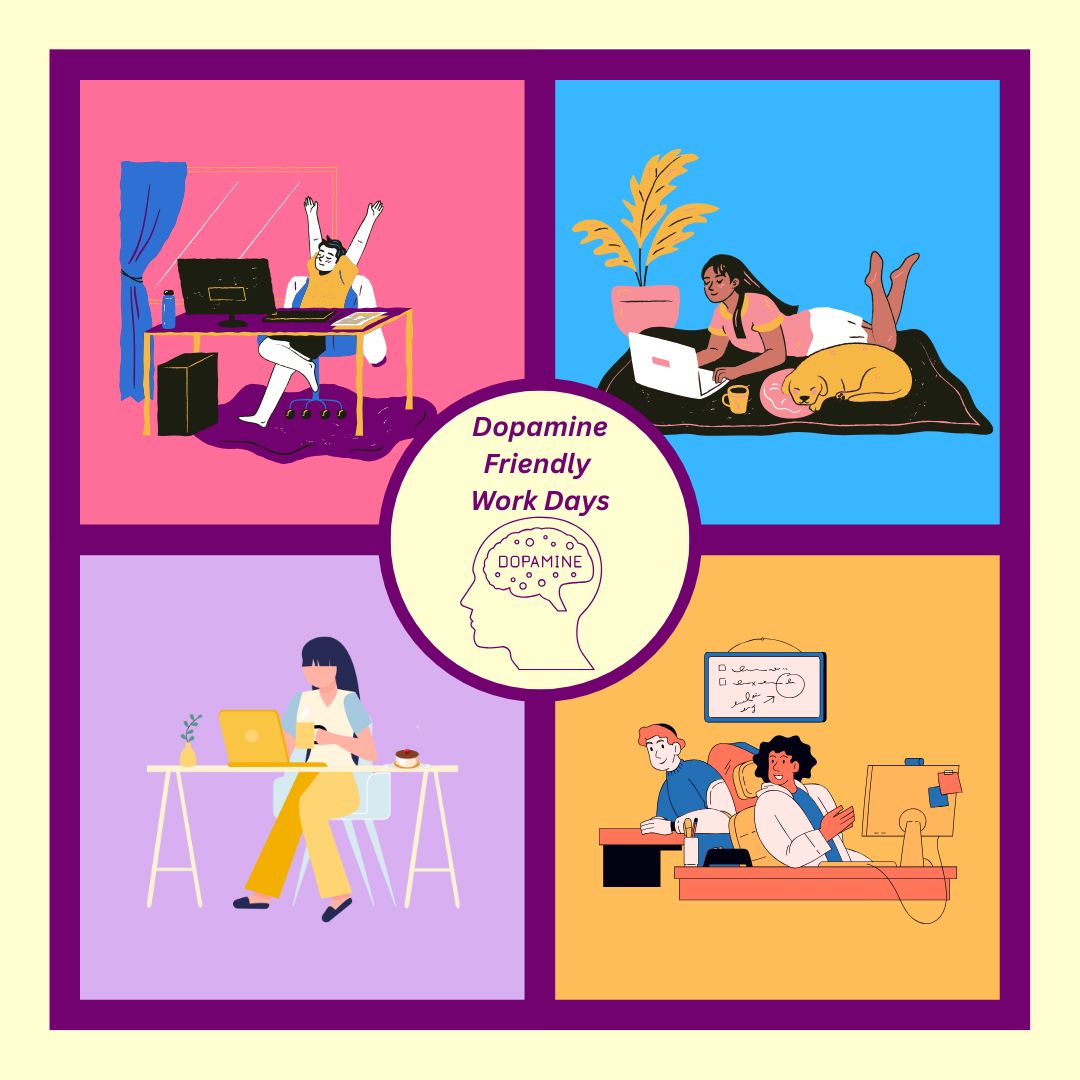
Creating dopamine-friendly workdays is a way of mapping your energy, your body’s natural rhythms, and working your day around the things that you your brain activated. It’s less about creating a rigid schedule or a magic productivity formula and more about building a day that answers questions like, “what is my energy level right now?” and “What kind of task matches the energy I currently have (not wish I had or think I should have.)?”
Let’s chat about specific things that make a day more supportive of your brain and bodies dopamine needs. Not as a prescription but more as a tool box you can mix and match.
- Map Your Dopamine and Energy Levels – Many ADHD adults (and kids) develop patterns, even if they feel chaotic. Examples might be: morning drowsiness → mid morning surge → afternoon crash → late night brilliant clarity. Cycles can shift with hormones, seasons, time changing, sleep patterns and more. For me, I’m most productive in the morning or at night – my afternoon energy is always lower than the rest of the day.
- Create A List Of Tasks That Match Different Energy and Dopamine Levels – If you can, you want to try to match tasks to your energy and dopamine levels instead of forcing yourself into someone else’s schedule. For me – I try to save things like learning or decision making for mornings when my energy is at it’s best and I feel like I learn better. Then medium energy work is more like admin work, scheduling, medium effort to do. Then when I have low energy I can do just what absolutely needs to be done and not feel guilty about it.
- Include The Dopamine Supports That Work For You – We all have our own dopamine boosters – and we should include some of these in our dopamine-friendly workdays. Your boosters might look like a mid-day walk, a hot cup of tea or coffee, your favorite play list, or watching a funny video. It can also be things like co-working, snacks, sensory comfort, and movement. This is about supporting our nervous systems. The very first thing I did when I opened my business was consider my schedule – I have two-hour lunch breaks, I only see clients 3.5 days a week, etc. I’m very privileged to be able to do that, but work in support where ever you can.
- Recognize When You Need To Rest, Not “Powering Through” – Sometimes your brain needs rest, sensory downtime, emotional decompressing, co-regulation, a break! Making a dopamine friendly day respects things like capacity not only productivity.

Build Your Dopamine Friendly Workday – Practical Tips
Our systems are not set up to be dopamine-friendly in the work place – at least not in the US. We have to make it a practice. A way of moving through your life with a sense of discovery instead of guilt and shame.
Let’s chat about some simple approches to building the dopamine-friendly workday that might work for YOUR brain.
- Start Your Day With Checking In, Not Checking Boxes
- Instead of just jumping in to your to-do list, ask yourself where your energy is right now. What is realistic to work on right now and what feels unmanageable?
- Do a mid-day check for energy shifts – or as often as you’d like.
- Create Your Task Menu – Not Rigid List
- Try grouping your tasks into high energy, medium energy, low energy.
- Or you can try grouping them by categories like – creative, administrative, social, zombie time and match tasks with those. Make sure you include breaks and down time.
- Include things that will active you or rev you up, things that will help you reset when needed, or regulate when disregulation hits.
- End The Day Punch Out
- At the end of your work day, whatever that looks like for you, instead of looking at how many things you did or didn’t check off of your list, try some of these questions instead.
- What am I proud of today?”
- What needs to come with me for tomorrow?”
- Did I have any trouble spots?
- Jot down any note for tomorrow
- Close the day with no shame
- At the end of your work day, whatever that looks like for you, instead of looking at how many things you did or didn’t check off of your list, try some of these questions instead.

Reminder – This is about honoring your brain – not being the productivity police.
The goal isn’t to cure our ADHD – or becoming a perfectly organized, hyper discplined version of ourselves. It’s about building days that align with how our brains naturally work – energy fluctuations, dopamine fluctuations, and nervous system reactions. When you can listen to and work with your brain instead of fighting against it guilt fades, activation becomes easier, burnout drops and you actually get some stuff done.
Here’s your challenge – pick one tiny thing from this blog to play with this week. Pay attention to how it works with your brain and how it feels. Build from that.
Questions? Feel free to send me an email at Kat@AllBelong.com and let’s chat!

 Don’t Delay Joy
Kat Sweeney, MCLC