
Book A Call With ADHD Coach Kat Today
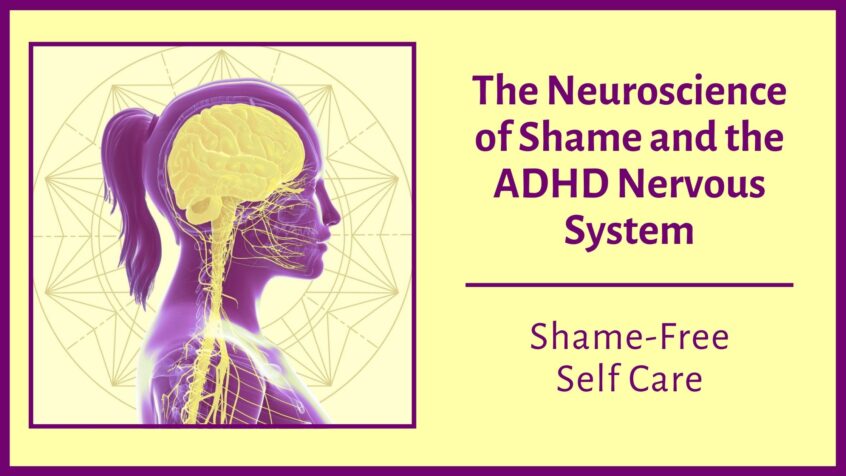
The Neuroscience of Shame and the ADHD Nervous System
Shame-Free Self Care
Let’s chat about shame for a minute. We’ve just about all felt it – that sinking feeling in the pit our the stomach that says “something is wrong with me.”
Not that we made a mistake, but that we are the mistake.
For many of us ADHD and neurodivergent humans, shame shows up at an alarming rate. It shows up when we miss a deadline, forget an appointment, forget a birthday, trip over another ha-finished project, or forget what we are talking about mid-discussion with someone.
Then the shame monster shows its ugliness – Why can’t I just get it together?
Some folks – too many folks – somehow think that shame is motivating. That if we feel bad about something we will finally do it right….do it better. But here’s the problem with that – shame doesn’t motivate the ADHD brain. In fact, it often makes things much harder.

Shame Activates The Brain’s Threat Response
A lot of humans with ADHD, neaurodivergence, PTSD, etc. have brains that are scanning for safety nearly all the time.
The brain then reads shame as a social threat when it shows up. Shame is not a safe feeling.
Humans are wired for belonging and connection – so feeling judged or “not good enough” can activate the same stress symtems as a physical danger might.
It might case a person to
- shut down
- to feel overwhelmed or frozen
- disassociate
- have trouble clearly thinking or making decisions
- feeling irritable or defensive.
When our threat response activates, our brains focus on protection, not problem solving. The prefrontal cortext part of our brains – the part that is responsible for many executive function skills like planning and decision-making – doesn’t function well when our nervous systems feel attact.
ADHD brains already struggle with executive function skills, and shame makes it extra difficult to get through. So when you introduce shame to the equasion, executive function skills become harder to use.
The Shame-Executive Function Loop
ADHD humans receive exponentially more negative input from peers and authority figures throughout their lives. We have heard a lifetime of
“You need to try harder.” “You just need to stop daydreaming.” “You are so smart – why can’t you apply yourself.” “Sit down, sit still, be quiet….”
Over time, we repeat the negativity to ourselves. For many of us, shame creates a loop that looks something like this:
Struggle with a task → feel ashamed → nervous system activates → thinking skills drop → struggle increases → more shame.
Instead of raising motivation, shame tends to reduce access to the very skills needed to move forward.
We genuinely want to do the thing – send the email, clean the kichten, pay the bills, even decide what’s for dinner – and end up feeling completely stuck.
It’s not because we don’t care. It’s not because we are lazy. Often, our nervous system has already made a shift into threat mode. Threat mode is not particularly helpful for things like planning, prioritizing, or even task initiation.
Now, when something goes wrong, our brain doesn’t see an “oops.” Our brain remembers years and years of similar moments. All that history makes the shame response show up faster and louder, making it even less likely that we can get or keep our nervous system regulated.

Compassion Is What Helps The Brain Re-Regulate
This is why shame-free self-care becomes so important for us. It’s important for everyone, but it’s vitally necessary for our brains to re-regulate.
Compassion as self care isn’t about making excuses for yourself or letting yourself off the hook.
It’s about creating enough safety in your nervous system to allow your thinking brain to come back online, out of safety mode.
When we shift our thought process from being critical of ourselves and into being curious, something changes.
Instead of asking, “What is wrong with me?” we might try one of these instead
- “What made this difficult today?”
- “What would support my effort to do this task?”
- “What tiny step could I take?”
Curiousity with ourselves (and others) engages problem solving, whereas punishment and negativity usually shut problem solving down.

A Tiny Relfection
Try this the next time something goes sideways — a forgotten task, a missed plan, a day where your brain just refuses to cooperate — pause for a moment and try to notice what voice shows up first.
It is shame? Or is is curiosity?
Because sometimes the most powerful form of self care is NOT fixing the problem immediately.
Sometimes it’s choosing not to attack yourself while your figure it out. Sometimes it’s choosing to be gentle and kind with yourself.

 Don’t Delay Joy
Kat Sweeney, MCLC, ACC